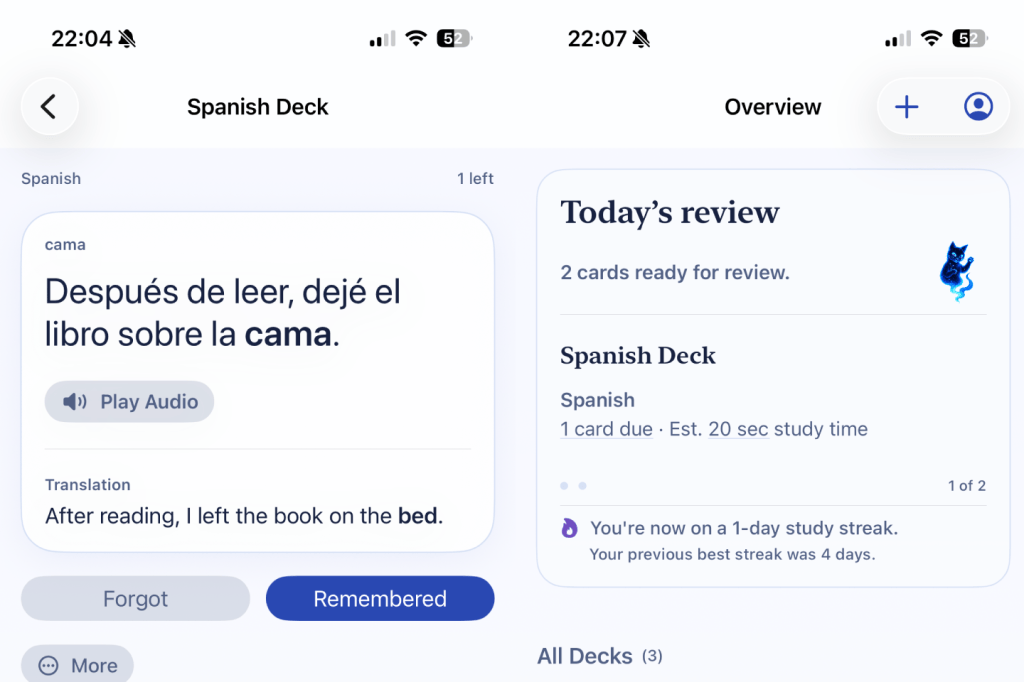
Although the technical implementation has evolved since development began in 2024, the concept has remained unchanged: flash cards are more effective if they mimic real life immersion. Traditional vocabulary study with flash cards, whether through Anki or pen and paper, comes with significant flaws.
Traditional Flash Card Flaw #1. Human beings do not learn their own language from dictionary pages. Five year olds are shown a picture of a cow in a book and told they go “moo.” The are not taught that the word “cow” means 1. the mature female of a bovine animal, especially of the genus Bos; 2. the female of certain other mammals, as elephants, seals, and whales; 3. to frighten with threats, violence, etc.; intimidate; overawe. That’s too much to remember for even a simple word. Words are learned through varied context and repetition over time. Unfortunately traditional flash card study is modeled on dictionary study.
Traditional Flash Card Flaw #2. Good examples are too easy to learn. This should be evident to anyone familiar with the use of mnemonic devices. Because the phrase “The cow jumped over the moon” is hard to forget, the brain doesn’t have to recognize the individual words. When the word “cow” or “moon” appears in other contexts, the learner may struggle to recognize which word means what, if they recognize the word at all. Unfortunately traditional flash cards allow the brain’s extraordinary pattern recognition ability to cheat itself out of true vocabulary study.
The Solution. Lingjini allows flash cards to change over time, so language learners are exposed to new contexts and word associations that insure a word is learned as it relates to the language rather than as it relates to the card. This is only possible through generative AI, and until early 2026 could not be done with reliable accuracy without expensive consumption of cloud-based large language models.

